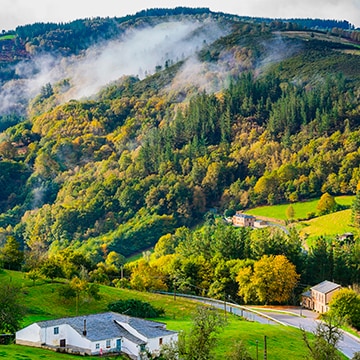
Galicia, the greenest area of Spain, and the area with the strongest seafaring culture, has as its main tourist centre, Santiago de Compostela. For centuries this has been the point of pilgrimage for those following in the footsteps of the Apostle James. The wild cliffs of the Rias Altas offer a wild and magical face to the region, whereas the Rias Bajas are more adapted to tourism, with quiet beaches, villages with roots in the seafaring past and excellent local cuisine. Inland, where the countryside is less well-known, there is the chance to discover dense areas of forests and mythical landscapes crossed by a thousand rivers and where the way of life is still anchored in tradition.
Location
Comprising the provinces of A Coruña, Lugo, Ourense and Pontevedra, Galicia is located in the northwest of the Iberian Peninsula. It is the westernmost region of continental Europe, bounded on the north by the Cantabrian Sea, on the south by Portugal, on the west by the Atlantic Ocean to the east and Asturias and Castile and Leon. A well as the mainland, the community of Galicia includes the archipelago of the Atlantic Isles National Park with the islands of Cies, Ons, Salvora and others. The Galician terrain is mostly smooth, with low mountain ranges. Its coastline is vast, stretching for over 1,600 kilometres; it is typified by estuaries - river valleys flooded by the sea - divided into the Rias Altas and the Rias Baixas. The 340 kilometres of the Miño makes it Galicia's most important river together with its tributary the Sil.
Climate
Ranges between oceanic and Mediterranean. In general, limited temperature variation, with moderate temperatures and abundant rainfall.
Population
2,767,524
Cuisine
Local fish and seafood are the most typical ingredients of Galician cuisine. Many types, including octopus and squid feature in the region's speciality tapas. Other important recipes are typically based on meat and vegetables: caldo gallego - a soup made with ham bone and greens, stews, roast or grilled beef, shoulder of pork with turnip tops, and the many varieties of empanadas - pies and pasties. In addition there are pimientos de Padron - small, and occasionally hot, green peppers fried whole and salted, Arzua cheese, and the soft, mild Tetilla cheese. Among the sweets are torta de Mondoñedo - a rich pastry, sponge and fruit concoction, tarta de Santiago - an almond tart, and filloas - the local style of crepe. Typical alcoholic drinks include white wines such as Albariño and Ribeiro, as well as stronger drinks such as orujo, either white or the yellowy-green orujo de hierbas, queimada - a hot punch prepared with spices and sugar and set alight in the pan - and coffee liqueur.
© 2000-2008, HOLA S.A., Madrid – Miguel Ángel, 1 – 28010 – Madrid (España)